2023/08/06

Not Pretty Enough (Kununurra to Katherine, Nitmiluk National Park and Kakadu, WA)

For the sake of brevity, my dear reader, I am going to combine two days into one entry. Brevity and the fact that there was nothing much to report. Breakfast in Kununurra was at 6am. I retired, hoping never to hear an alarm again and I've heard more alarms, mine and others, in the last couple of weeks than I've heard in the three years. And that's not a good thing.

The bonus today is that we are on the Victoria Highway and it is paved. Smooth sailing. Comparatively.

The first stop of the day was at Timber Creek for brunch. Of most interest was an electricity outage being experienced by the Roadhouse. Aside from the lack of light in the shop, the fuel pumps had stopped working as did the cash registers. It didn't take long to have the power restored but it created a very large backlog/traffic jam of cars attempting to refuel.

It was interesting watching the 4WDs and their accompanying caravans, trying to finesse their way through the log jam. If you are now imagining the sort of caravan you might see on the road in NSW, dear reader, you are mistaken. Think of a NSW van on steroids and then fortified by black sheet metal to protect it from stones. And then, add a boat to the top of the ute and you get the picture.

As interest waned in the fight for a petrol bowser, a fire sprang up across the road. It was not an authorised 'cool burn' and it appeared to have started at the road's edge. Perhaps a stray cigarette butt. I know, people over here still smoke. What is that about? Imagine being able to afford a 4WD, boat, van and still have money for diesel and ciggies! As we were told in Karratha, the mines pay really well. Guess I chose the wrong the business, but I still rate retirement.

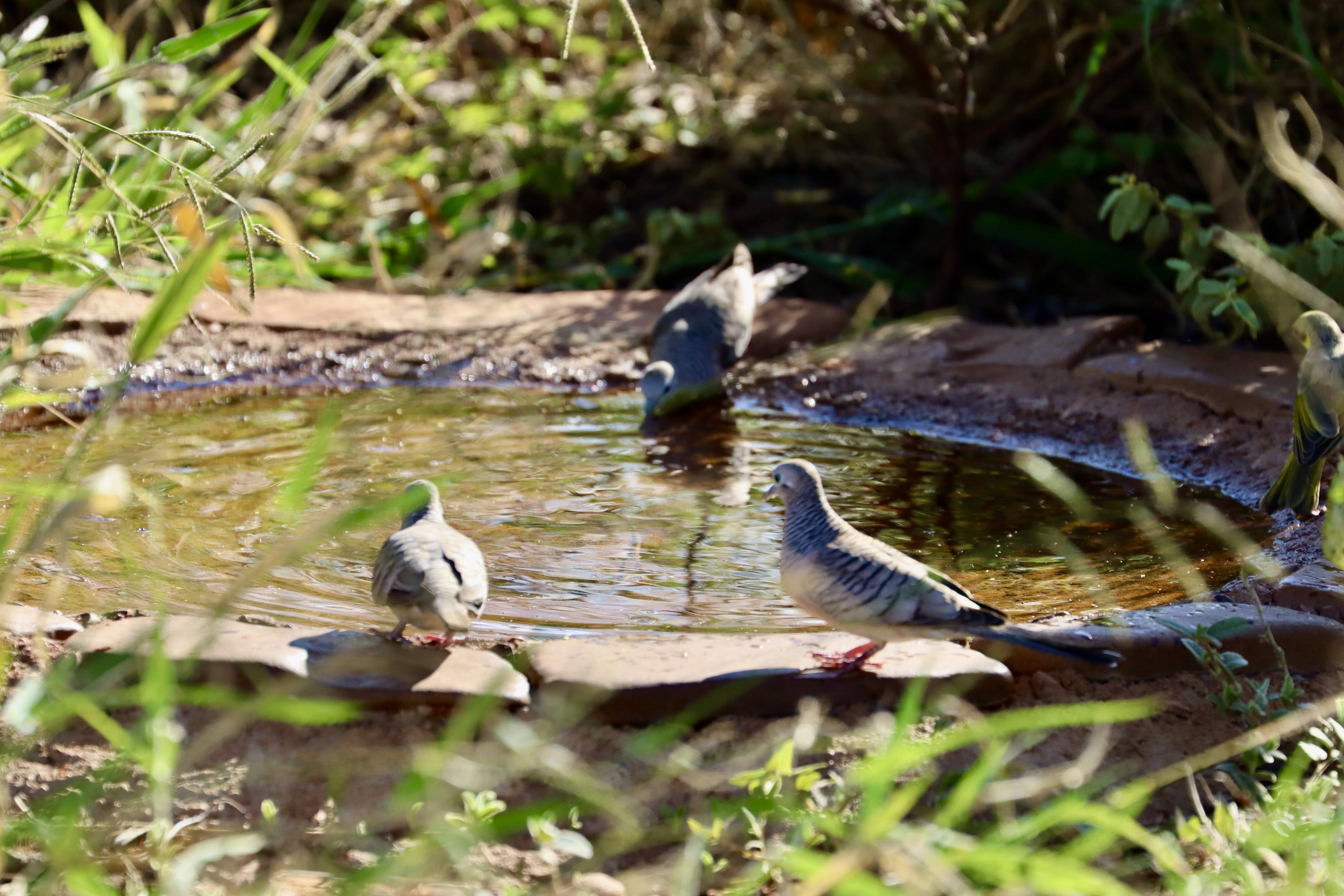
The next stop was afternoon tea, where a chocolate ganache cake was magically produced to celebrate a birthday. I saw some red-winged parrots and a fawn diamond dove - an unusual mutation in the wild. There were also some long tailed finches but they proved too elusive for my camera.

A fawn mutation.

That afternoon, we rolled into Katherine for a one night stay and to visit the local bottle shop because our next accommodation in Kakadu is unlicensed, although they are happy if you bring your own.


The bottle shop was supervised by two big, burly, well-armed NT police officers. ID had to be produced prior to entry where you had to guarantee the alcohol was for you and that you weren't supplying any of the "dry" indigenous communities. ID then had to be produced again before you were served. A most interesting process. The stock was quite limited and expensive. They could really do with a Dan Murphy's  outlet.

Canapés and welcome drinks kicked off the evening. Most discussion centred around which wine was the most palatable. It wasn't a wide choice or a long conversation.

Not pretty enough to be up before 5am.

Breakfast the next morning was at 5:30am. Jayne was confused. After retirement she had convinced herself there was only a 5:30 in the evening. The even earlier start than usual was to cram everything in to a packed itinerary for the day which began with a cruise of Katherine Gorge. The sunrise was completely unremarkable. In fact, it was not pretty enough to warrant getting out of bed. Ah, you picked, dear reader, the link to today's title. Who'd have thought I'd ever chose a Kasey Chambers song? Not me.

It was very cold on the water early in the morning. Yes, dear reader, even I succumbed and put on a jumper. Any thoughts of increased bird life in the early dawn were soon dispelled. The cruise was interesting, but if you can opt for a later time slot, take it.

The Greater-billed Heron

Part of the way down the gorge we had to swap boats because of a block up of rocks. The 10 minute walk to the next boat got the blood recirculating and we continued the cruise into the rising sun and glare.

No boat was going through there.

Nitmiluk is home to the Jawoyn people and contains their stories and history. It is a series of gorges, not just one, separated by a series of 'block-ups' in the dry. While the area is considered safe for swimming there are occasional sightings of estuarine crocodiles and they have a number traps set along the river.  Aside form the traps there also red floats attached to chains. Apparently crocs are curious creatures and can't resist testing out the floars with a quick bite to see if the are friend or food. A thumb-sized hole in the float means it's time to get the tourists out of the water.

Looks good enough to swim.

Better check the float first.

It was over all too soon and we were back on the bus heading for Kakadu. The next stop, morning tea at Pine Creek, home of the Hooded Parrot. 

A pair of Hooded parrots.

Of course there was a stop for lunch. We were covering a lot of ground again today. The Kakadu Cultural Centre was our destination. It is well worth a visit, the grounds are well looked after and shady, making it a great spot for lunch. The Cultural Centre has an excellent gift shop with everything from art works to T-shirts to books and nick-nacks. It also houses an interactive display that covers history, story and arts/ crafts and technology such as fish traps.

Then it was back to the tarmac that would eventually be traded once again for red dirt, as we entered Kakadu and located Hawk Dreaming, our home in the wilderness for the next two evenings. But before it was time to rest, we had another cruise, this time on Yellow Water Billabong, home of the Bininj people.

Green-pygmy goose on the wing.

The dominant male.

I cannot rate this cruise highly enough. The local owners were referenced throughout. the guide was knowledgeable and there was an amazing abundance of flora and animal life. I will let the pictures take you there.


A tern. Probably a Common Tern. There were a lot of them.

Black-necked stork, akaa Jabiru.

Egret and lotus lillies.

The ubiquitous Rainbow Bee-eater

That night we treated to the most amazing dinner by Rung. Home-cooked Thai green curry. It was the best meal we'd had since the tour began and was probably the biggest distance from civilisation.

A pair of White-bellied Sea Eagles.

Azure Kingfisher.

Sadly, that was not the end of our night. The meal was excellent, the drinks around the fire were fabulous, despite the squadrons of mosquitoes attempting to carry off various members of our party. Then, at 2:21am, soundly asleep and dreaming of photographing Gouldian Finches, the peace was shattered by our smoke alarm.

The fire had died down and I could smell the smoke as the heat went out of it. I found the alarm and pushed the button. Silence. Excellent. Back to bed. About 10 minutes later it went off again. I bounded out of bed, pushed the button and disengaged the alarm and placed it under my pillow. Once again the night was disturbed only by the woof woof of the Barking Owl. Just as I was drifting back to sleep, BEEP BEEP BEEP, from under my pillow. Jayne's suggestion of "Bury the thing,' although top of my list, was not helpful. I grabbed a T-shirt and wrapped the alarm carefully and then returned it to beneath my pillow.

It didn't sound again until I got up in the morning. It accompanied me to breakfast where Rung listened to my explanation, smiled, and said "Cabin 4?" From that point it proceeded to go off every ten minutes. Persistent and overly-sensitive. Cabin 4 would be operating outside fire and safety regulations the next night.

I learnt a new word today. Bobo. The spelling is subject to animated discussion, but Bininj people prefer not to say goodbye, they would rather say, until next time. Or in their language, bobo.

Bobo.

2023/08/05

From Little Things Big Grow (Purnululu National Park to Kununurra, the Ord River and Lake Argyle)

Today we were facing another 6 hours in the bus plus the regular stops. Another long day, dear reader, that would land us at Kununurra Country Club by 5pm. This is to be our base for the next two nights.

After a morning tea stop that was eminently forgettable, we ended up back at Doon Doon Roadhouse for lunch. This time, however, we made use of the campground kitchen area, next door to the roadhouse, where the toilets were actually clean.

Frangipani flowers.

At some stage on the trip, one of our group noticed that our published itinerary was different to what we were doing. It was put down to computer error. In reality, it was computer operator error - they were obviously doing a cut and paste from the circular Broome to Broome trip into our tour and omitted to delete some of the activities from the other trip. It was with some disappointment that we discovered we would not be visiting the Kununurra distillery.


The Hoochery

Our guides had other ideas and, as we had been very prompt and punctual during the day, without notice, we found our tour vehicle pulling into a car park to allow us to visit the Hoochery as the distillery is named. They make various spirits such as a corn based whiskey, gin and rum. The painting behind the bar was reminiscent of a 1950s or 60s public bar from any early opening hotel in Australia. All class.


I'm not sure how this relates to the alcohol on sale.


Zebra Stone

After a few of the group sampled the wares and purchases were made, we decamped to the Kimberley Ornamental Stone Craft shop. Zebra stone is unique to the Kimberley and is used in jewellery, sculpture and some household wares such as cheese knives. It is quite an unusual stone and a high level of skill is required to work with it successfully. The most unusual carving was a massive crocodile about 1 metre in length. It had already been sold. The most twee item was a zebra carved in zebra stone. I see what they did there.


Ivanhoe Crossing

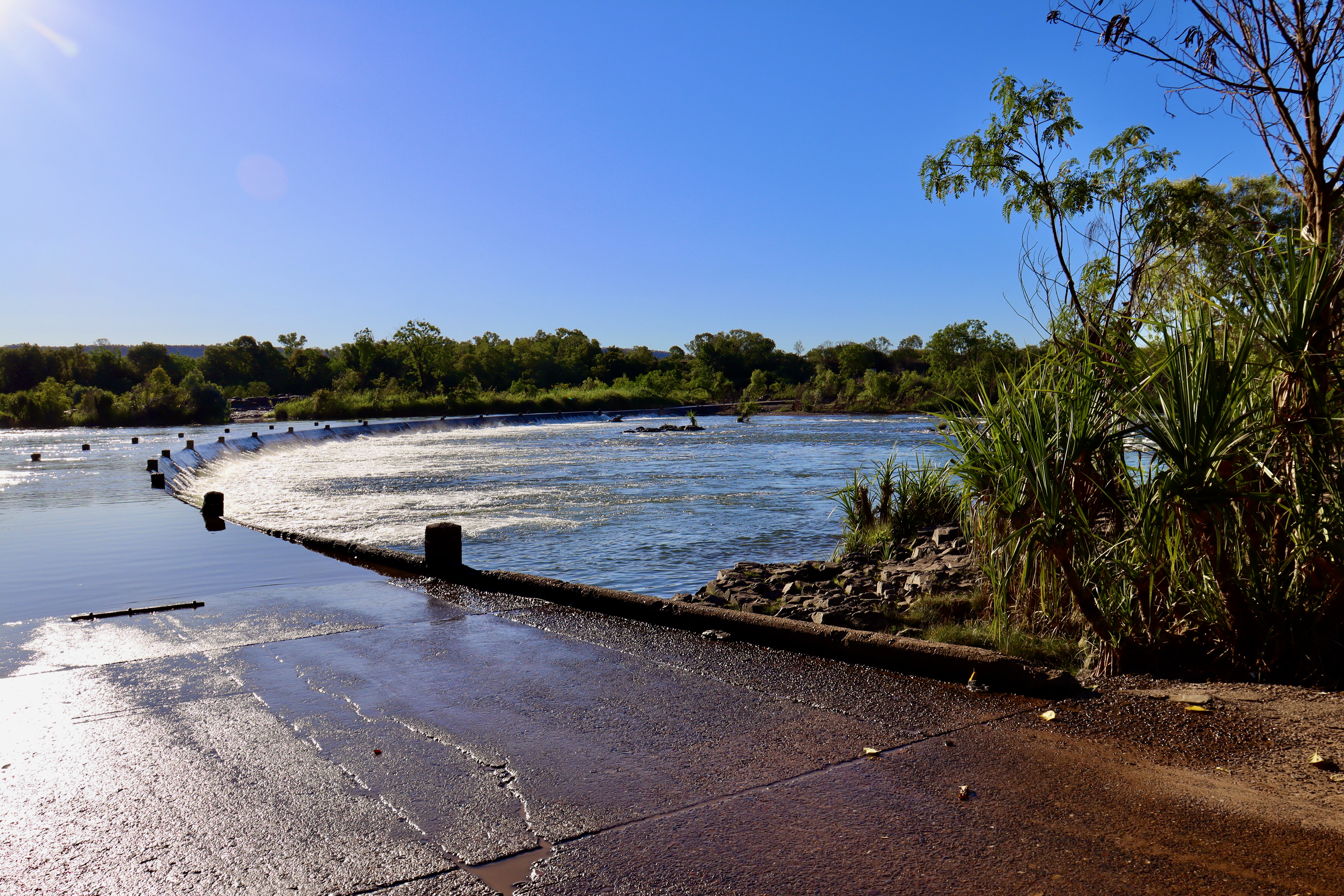
The final stop before the Country Club was the Ivanhoe Crossing on the Ord River. For reasons beyond my understanding this is a tourist spot. Perhaps because crocodiles frequent the area. Having been warned not to go near the water's edge, we managed the obligatory photos and returned to the bus safely to discover the carcass of a lengthy black snake behind the bus. It was probably a whip snake as the black snakes we get on the east coast are not endemic to WA.

The croc lives in this pool.

The Ivanhoe Crossing.


The Country Club

The Country Club is located next door to the Kununurra outdoor cinema. This proved to be a surprise as we left for dinner. I could hear the soundtrack to the movie but had no idea where the noise was coming from, until I stepped outside and could see the screen beyond the fence, between the trees.

No idea, but pretty.

We had pre-ordered dinner and the efficiency of the staff was such that the meals were arriving at the table prior to the guests and the appointed time for serving. Some members of our party came to the table to find their entrées already going cold. This was a curious piece of efficiency which they could have applied to the organisation of the bar. One person operated the till where all drinks had to be ordered, to then be served by another person, standing next to them behind the bar. Meals also had to be ordered with the same person. Consequently there was a queue out the door.

The main meals were enormous. I ordered a squid ink linguine and there was enough pasta and seafood on the plate to easily feed two or three people. Oversized serves really are a waste, but then again, this is WA, everything is oversized.

The Country Club appeared to be striving to be something that it is not and as a result just falls short of the mark. The extra large meals, the poor bar organisation, the rooms over crowded with furniture. In our case there was table and two chairs in our room. If we both sat at it, it was not possible to open the door or access the bed. Clearly there were issues with the level of the flor or the table legs and our table had been thoughtfully chocked for us.

Stylish and classy.


Coffee and Cockatoos

The following morning, during some rare free time, we went in search of coffee. Proper coffee. I eschewed the café recommended by our guides, as I had been burnt more than once by their perspective of 'good coffee'. We settled on the Wild Mango Café and I enjoyed a more than reasonable coffee. Finally.

Shortly after, I received a call from Kylie telling me of a flock of Red-tailed black cockatoos, not far from where we were. A quick trip back to the Country Club to grab my camera and I was off in search of these beautiful birds. Again, success. An excellent start to the day.

Flashing his red tail.

Not sure he wanted me around.


The Durack Museum, Lake Argyle and The Ord River Scheme

Later that morning, we were collected at the country club to go on a day trip. We had actually experienced this activity in 2019 as a part of the Ponant cruise. The only difference this time was that commenced in Kununurra rather than at the dam wall, so we travelled the river in reverse.

Never smile at a crocodile.

The Durack Museum, the re-built homestead salvaged from the rising waters as the lake formed behind the dam wall, was as uninspiring as I remembered it. It is a memorial to all things Durack. I noted in a previous post that "Australia's white history has a black past" well, that doesn't apply to the Kimberley. It's history is white as the driven snow. It commences with a Durack and concludes with a Durack and there are only white fellas in between. Aside from the occasional black stockman or stories of Vincent Lingiari. Who'd have thought this land had been continuously inhabited by the oldest living continual culture for over 60,000 years?

Today's title comes from the work of Vincent Lingiari and a collaboration between Kev Carmody and Paul Kelly, From Little Things Big Things Grow. You'll know when you hear it, but listen to the lyrics if you haven't before.

I'm batman.

The Lake Argyle is impressive and, as I have said before, the scheme appears to be one of the few positive things that white man has done for this country. It has worked better than the introduction of rabbits, foxes, cane toads, blackbirds, sparrows, lantana, black thorn, Patterson's Curse ... I could go on, but I think you get the point.

Australasian Darter.

The Ord itself is now an established waterway and wetlands, year round. Without the boom/bust cycles of the wet and dry seasons, local flora and fauna thrive. Birds, fish, freshwater crocodiles, wallabies, all are secure in their numbers.

Nankeen Night Heron.

The only criticism of the JJJ Tour was the same one guests made back in 2019. There was next to no recognition of indigenous association with the area. Last time there were complaints made and I was expecting, no, hoping, this would be rectified. Sadly not. The guide was very knowledgeable, although not from the area, and acknowledgement of the original inhabitants was restricted to two mentions. This is Durack country.

Azure Kingfisher.

The previous tour commenced on the water in the morning, today we finished at Kununurra with another overrated Kimberley sunset. There was much more bird life on the morning tour and if I had the choice, that would be my option. That said, I still enjoyed the cruise down the Ord.

Rock Wallaby.


An estuarine (salty) crocodile trap.


An Intermediate Egret on the wing.


Tonight is our last night in WA; tomorrow we cross into the Northern Territory.


Sunset on the river.

Until next time.

2023/08/04

I Still Call Australia Home (Purnululu National Park/The Bungle Bungles, Picaninny Creek, Cathedral Gorge)

Today is the THE DAY, after so many years of waiting and wanting, we are spending almost the entire day in Purnululu National Park or The Bungle Bungles, as they have been known since white fellas came to the area. Not even a Bruce McAvaney "special" can sum this up, dear reader. Although it is just so special.

I'm certain we stopped for morning and afternoon tea, somewhere, or carried it with us, but it is of no import today.


The domes and a local Grevillea.

There was a short drive from the lodge to a viewing spot in the national park. The beehive shaped domed are as impressive as I imagined. But beehive shaped? The only beehive I have ever seen shaped like a dome was in Yogi bear cartoons. Native bees in Australia hive in tree hollows, as do the European bees that have escaped the professional keepers.


The domes of Purnululu are another amazing piece of the landscape out here. I'm going to minimise the written text and let the pictures do the talking today, but first a brief lesson in the geology of the area. Thanks to https://www.kimberleyaustralia.com/bungle-bungles-ranges.html.


The domes are sandstone that was estimated to have been laid down around 350 million years ago. Weathering as a result of wind, rain, heat and cold wore away at the weaker sections of rock. This erosion is constant and ongoing today. Fault lines of weakness in the ground can be viewed from the air.

The darker layers in the rock have a higher clay content and as such hold more moisture than other layers. The moisture allows for the growth of cyanobacteria, a kind of primitive algae. This microorganism protects the layer in which it grows, which slows downs erosion. The orange colour in the remaining rock comes from oxidation of iron.

The view from Picaninny Lookout

Massive rainfall in the wet season has gradually carved out the softer rock and created the creeks, canyons, chasms and gorges that we see today.

Heading into Cathedral Gorge

Another Grevillea.

We commenced with our walk to Picaninny Lookout. Those feeling less confident detoured before the end point and headed straight to Cathedral Gorge where we all met up later in the day. I'm sorry the photos don't do it justice, I didn't have a lense with a wide enough aperture to capture the height.

You might recognise Cathedral Gorge from the Qantas ads featuring the Australian Youth Choir singing I Still Australia Home. Eventually. If the flight wasn't cancelled. Although their luggage probably didn't make it home. And I doubt they were flying using Frequent Flyer points, that's almost impossible. Sorry I digress. As you can tell my dear reader, my love affair with Qantas is well and truly over.

Anyway, today's title is the original Peter Allen version of the song.

The pool at Cathedral Gorge.

Colours changing as the sun moves.

The shapes, the colours, and the remote, unspoiled beauty of the area were marred by the relentless march of the introduced species, cane toads, across the top end. They were evident everywhere and are having a major, deleterious impact on native wildlife. Animals that try to eat the toad end up being poisoned and a program has commenced to try to train the locals not to eat the introduced pest.


A couple of young cane toads.

After we walked out of Cathedral Gorge, lunch was enjoyed at the HeliSpirit airstrip as we waited patiently for our flight over the national park. There were three different flights you could enjoy, 18 minutes or the longer 30 minutes, up to 42 minutes. Not being huge fans of flying in helicopters with no doors and only rudimentary seat belts, we opted for the shortest flight.

We scored the red helicopter.

Just as spectacular from the air.

In the meantime, I was kept entertained by the possibility of bird watching. There was an artificial pond near the administration building that had previously been host to some Gouldian Finches. I was sceptical about that, but there were plenty of other avian visitors that afternoon.

The range goes on forever.

This area was used to hold mustered cattle.

The chopper flight was magic and the domes of Purnululu looked even more spectacular from the air. Uluru is special because of its sheer size and domination of the surrounding landscape. Kata Tjuta engenders a magic cathedral-like spirituality. Purnululu is different again. It rises from the surrounding landscape without dominance of the rock or the spiritual feeling of 'The Olgas', but the shapes and colours create their own level of wonder and awe.

That evening, we adjourned to a local spot not far from the lodge to watch the sunset. Supposedly. We actually left for dinner before the sun had gone down completely. Aside from that, the colours weren't that great. I've seen better in Redfern. Watching the changing colours on the surrounding ranges is more impressive.

Colour changes on the mountains are worth watching.

A Kimberley sunset ... pretty average colour.

All in all, an awesome day.


Bucket list ticked.


Until next time.