Showing posts with label Bjerke. Show all posts

2024/03/18

I'm only happy when it rains (Bergen, Norway) Part 2

The journey through Bergen continues dear reader with a new title. I'm only happy when it rains by Garbage. I assume they must have had Bergen in mind when they wrote their 1995 hit.

Sorry if the timeline seems out of kilter, but this is a post that was pulled together over four days and you need to accept that time in this post is not linear.


The Stave Church

The first glimpse.

Another church, and this one has a most interesting history. It is, of course, wooden in structure and is covered in tar to protect it from the elements. The Norwegian word 'stave' refers to its construction where solid timber beams (staff) are used as support. There were thousands of stave churches in Norway but a piece of long-ago legislation, decreeing the acceptable minimum size of a church, resulted in most of them being destroyed. About 28 remain and all share the same feature of being constructed using no nails. Every piece is interlocked and can be deconstructed and reconstructed as often as necessary. Ani describes them as lego churches.

Haunted?

The tar renders the church totally black and creates a medieval, if not totally evil, picture. It also made it a very easy target for arsonists. The last person to burn it to the ground was the father of ‘black metal’ or ‘death metal’ as we refer to it in Australia. In fact, Bergen is the home of death metal. Wouldn’t you be proud? Home to a music genre that is populated by angry white boys who play their instruments badly and loudly and can’t sing in tune.


The Funicular
One of the main attractions in Bergen is the funicular ride up the mountain from right in town. It is typical of other such rides we have undertaken in places like Budapest and Wellington in NZ, but the vehicle itself is very modern. It holds nearly 100 passengers who stand in the compartments for the few minutes it takes to go up or down the mountain. 

The Venus is down there somewhere.

At the top, are the ubiquitous gift shop, café and playground but the Norwegian twist comes with the addition of the Troll Forest behind the buildings. We didn’t venture into that area so I have no real idea of what it looked like. The rest of the area was fairly nondescript and we spent the majority of the brief visit at the viewing platform overlooking Bergen, taking photos and trying to identify where we had driven as well as where we needed to go the next day. 

Our hotel is near the yellow crane.

One landmark we were looking for was the Bergen Convention Centre and Grieg Concert Hall, a building that was part of the guided tour. This houses a permanent museum which honours Norway’s greatest composer. Its other claim to fame is that it is supposedly designed to look like a grand piano. We couldn’t see it from the street level and it wasn’t much more apparent from the bird’s eye view but …

Easier to see from on high.

After a quick tour through the gift shop, it was time to descend the mountain and take the short drive back to the ship.


The Venus
Before we went back on board, we spoke to Ani about our excursion that was scheduled for later in day. He confirmed our suspicions that it would cover much the same ground. We cancelled it and, after viewing the menu, also our reservation at the Chef’s Table, which meant we had ample opportunity to pack our bags to meet the 10pm porter collection deadline. After that and a leisurely nightcap, we spent our last night aboard the Viking Venus.

The following morning, we were off the ship before 9 o'clock and wheeled our bags the 20 minutes or so to our hotel. Cobble stones are quaint but they are not friendly to wheelie bags. It was a tough slog, but at least it wasn’t raining – and it was our second day in Bergen.


Hotel Oleana
The hotel is quite central. It’s about a 5 minute walk to the harbour front and 10 minutes to Central Station, which was my main consideration. We were surrounded by restaurants and bars and the museums were also inside a 10 minute walk. All excellent news in a city where it rains forever.

The view as you sit on the toilet.

Oleana is a self-described boutique hotel and is not large by any means. Breakfast was supplied daily for free. That was a nice surprise. The staff were lovely and welcoming although we arrived at 9am for a room that wouldn’t be ready until 3pm. So, what to do? We dumped the bags and walked the city.

The outside wall of the shower.

We walked to the station to ascertain how walkable it would be when laden with our bags. We checked out the park and the lake, then wandered down to the dock area, through Bryggen and went to exchange some money just in case we required any cash. We didn’t.

Back at the hotel after midday, we sat in the lounge and read and blogged until our room was ready. Now that was an experience. The room, not the lounge. The pictures say it all, but in Scandinavia they have these weird sleeping arrangements. Couples still share a bed but they have their own individual duvets. The theory is to allow a more peaceful sleep for both people who can then adjust the duvet to suit themselves. Well, after 3 nights I call bullshit. It made no difference whatsoever. In fact, we ditched the duvets in favour of a sheet that we brought from home. Explaining you want a sheet between you and the arctic strength duvet can be a challenge, we've found.

The bed - with our sheet.

Our room also had an interesting shower placement. It was in the middle of the room. Visible from the hallway if the door was opened. Best to telegraph shower plans if your partner goes out.

The shower.


Rosenkrantz Tower

Our wanders took us back around to Bryggen where we had been as a part of the cruise tour the previous day. One landmark we had seen that had not been included, was the medieval precinct that had been home to the royal family when Bergen was still the capital. 

It resembles a remnant keep because it is.

The fortified area is surrounded by a stone wall and contains a number of well-preserved medieval buildings including the prominent Rosenkrantz Tower. It was not open to the public to actually ascend but you can wander around the enclosed area to view the tower, a substantial church structure and a number of buildings that are now used by the Norwegian naval administration. There is also some open parkland and a lookout over the port as well as a parade ground.

Guildenstern was nowhere in sight.

The Museum
It was raining the day we visited the museum. Well, it had to happen. We rugged up in our waterproof coats and headed out. It appeared not to impact on the locals at all as they went about their business, dressed appropriately, most without umbrellas.

I know, of all the things to photograph. And, yes, it was real. Once.

The museum appears as the Münch Museum on Google but that is not accurate. It is a museum and it houses the Rasmus Meyer Collection. A fine collection of works it is too, of major Norwegian artists as well as a substantial number of Edvard Münch paintings. Enough to demonstrate the development of his work over a period of time. 

Well worth the visit, even if some of the more modern parts of the display are somewhat incomprehensible.


Food
Three days, three restaurants, three free breakfasts and no need to eat like we ate onboard the ship where everything was laid on constantly.

Bjerke was our first attempt to eat a more traditional style of Norwegian food. The restaurant is just near the harbour, with views of the water from some windows. We began the evening with the water views. We were seated only long enough to pour water and open the menu when the American man seated behind me gave such a solid, meaty sniff that I thought he would inhale his food. He really hawked back like he was going to spit. Classy restaurant behaviour - get a handkerchief I thought. This was followed by a gargling, throaty cough.

Jayne and I exchanged glances. Do you want to move? "No, it’ll be ok," I said. Moments later he was at it again. Sniffing to prevent a catastrophe from emerging from his nostrils, followed by a sickening cough. And so it continued, 3, 4 or 5 times. It was flesh-crawlingly disgusting. When the waitress arrived and asked did we want anything, Jayne requested we move tables.

We gathered our coats and water glasses and were moved to other side of the restaurant where the window looked out over the square. No water views, but I could breathe the air freely and our ears and sensitivities were no longer assaulted.

They love a statue, they are everywhere.

As we left Jayne heard the man's wife say, "That was a good call, them moving tables". What does that mean? He knew he was ill but came out anyway? Disgusting on so many levels.

The meal was good, if too large for us. Prinesfisk. Cod with shrimps, white asparagus, parsnips and potatoes, fried cabbage and butter puff pastry. The scallops I had as a starter were perfect.

Olivia is, from what I can see on Google, a chain of Italian restaurants across Scandinavia. We ate here on our second day for two reasons. First, it is the name of our newest granddaughter. Second, it was still raining and this was the closest option for dinner.

Good food.

It was good pasta and pizza. I would be happy to trust my appetite to this chain. Not that I need to eat pizza everyday. One interesting observation here was that in Norway, they do not serve a pizza pre-cut. It comes out whole and everyone eats it with a knife and fork. Weird.

We watched the people outside dealing with the rain as we enjoyed our meal. The locals were a standout, totally unconcerned. Then I spotted a couple battling the elements, she with an umbrella and he festooned in a Bunnings rain poncho, wheeling his suitcase to whatever hotel they were staying at. Aussies, totally unprepared. Smug, I had another sip of my wine and nudged Jayne, check that out.

A legendary Norwegian poet. So says the plaque.

Our final meal was at Fish Me at the fish markets. I'd read mixed reviews, some positive, some extremely negative. The complicating factor was there was another, more upscale restaurant next door. They probably shared the same kitchen. In the end, we opted for the more casual experience.

Winner. The food was brilliant. Scallops, again, were perfectly prepared. Jayne had fish and chips and was extremely pleased with the product. I had mussels and fries. Wow, I've never seen so many mussels in a dish. If we lived in the area this would be our go to place to eat out.

Repair work in Bryggen.

To wrap the dining experiences, the food here is expensive. Yes, we generally have wine with dinner, but still. The pizza/pasta dinner and a bottle of wine was around $200AUD and so was the dinner at Fish Me. Not cheap when you're travelling and need to eat out almost every night. I guess if we become desperate, we have spied the first McDonalds in Scandinavia since leaving London ... only joking. About eating at Maccas, not its existence.

And that is it from Bergen. Tomorrow we brave the rain to catch the train to Oslo.

Until next time.


2024/03/17

It might as well rain until September (Bergen, Norway) Part 1

Call it a senior's moment, but I was quite remiss not to mention Cruise Critic in the last post. Being ignorant of Cruise Critic is a positive thing, dear reader, and no thanks to Mary who cheerily introduced us to this erudite forum in the weeks prior to our departure. In short it is a website, but you need to become a member. There is no monetary cost, but the cost to your sanity is something else. Once you've joined, you can find your upcoming cruise, or look at others, and read the commentary from the members through a section called 'Boards' where a roll call group is created.

For our cruise there was, on completion, 21 pages of comments. I didn't count the number of individual contributors, however, from memory, one was from Scotland, one from England, two from Australia and the rest were from the USA. Not surprising given a Viking representative said that 85-90% of their business is from the States. Of course I am not one of the Australians who contributed to the pages. I lurked, dear reader, and maintained the safety of anonymity as the war of words was raged. Oh yes, it was quite nasty at times. Passive aggressive replies about dress codes, outright aggressive commentary about pre-booking shore excursions. Always concluding with some ludicrous, 'have a nice day' comment, while meaning the entire opposite. One person actually said, "I don't judge" while doing exactly that.

Who would have thought I would be demonstrating disrespect towards the staff by wearing jeans to dinner, as one overly judgemental person stated. I'm certain my jeans didn't impact on their wages and I've been treated nicely by suits and pearls as well as overalls and jeans. The reverse is also true, although there was more abuse from the nicely dressed. Money does not buy class.

Early morning heading to Bergen.

Here is a link to the 'Boards' page, but you'll have to join for access. Good luck, it is a slippery slope.

Back to the agenda. Bergen. We have overstayed our welcome, not because of something we have done. Well, it is really. There is only so much to do in this beautiful town and the weather restricts some activities. When rain is likely for 239 days a year, consecutive days without rain are miraculous! We achieved this feat on our first two days here.

Cruising into Bergen.

And so to today's title, It might as well rain until September. A 1963 classic from Carole King. It felt like it was going to rain until September. The locals are all very stoic about it. Dress appropriately and the rain is a minor inconvenience. Interesting in a town that is eminently walkable.

I'll break up the next section into the tourist attractions we visited as part of the cruise onshore experience. We were aware that opening hours can be seasonal. This is the lesser of the two shoulder seasons and some attractions are open for limited hours on one day a week.

Beyond the port, Bergen is etched into the hillside.

As previously stated, we arrived in Bergen a couple of hours late and all the tours were pushed back. This actually meant we would not be able to make our Chef’s Table reservation that evening if we attended our last shore excursion. That was still hours away and we boarded a bus for a 4.5 hour Panoramic Bergen tour which proved, happily, to be more off the bus than on.

Bryggen
Initially, we weren’t seated on the bus for more than three minutes. Given we’d been on board the ship for two days straight, I would have preferred to walk. However, we piled on and then filed off the bus and stood on a street corner while our guide, Ani, provided the background to the Bryggen area.

Decorations on houses were used instead of addresses.

The buildings that line the street, or wharf if you prefer, are all wooden. The various colours of the painted timber make for a picture postcard scene. It is an UNESCO world heritage site, like the Great Barrier Reef, although the Norwegians care about their heritage sites. There are a number of buildings undergoing restoration which is problematic. As a heritage site, they must be repaired using the same techniques and technology that was used in their original construction. While I understand the desire for authenticity, surely modern methods could be used if they weren’t going to damage the integrity of the historic aspect of the building?
Bryggen.

Ani then deftly switched the point of the walking tour and made his way through the group. Those that had situated themselves next to him were now at the rear. I’m sure my smirk was visible. One aging man (insert country of prejudice, oh alright, he was American) with a walking stick was clearly unhappy with this new arrangement and stepped from the footpath onto to the road to gain ascendancy and the front of the group. Sadly, the driver of the adjacent car anticipated his stupidity and drove around him as his wife called out, “Be careful, Jim.” One deftly placed shoulder on my behalf could have ensured his permanent removal from our group.

Bryggen Nightclub. Definitely no smoking.

Obviously, fire was a significant issue in a community of wooden structures and the area has burnt down several times. This, despite the absolute prohibition of any fires in any of the houses for either heating or cooking purposes. The subsequent rebuilding on dodgy foundations has had its impact and some buildings appear not to have been constructed with the use of a spirit level or string line. Extensive restoration work is being undertaken both inside and underneath several of the iconic houses as the sinking water table is impacting negatively upon the already undermined foundations – hence the list to one side. In fact, they are channelling natural rainwater run off into pits underneath the houses in a bid to keep the water table afloat.

Of course it is level.

While timber was a plentiful resource, fire is a necessity in such a cold, wet climate. Despite this, and the abundance of stone, it was rarely used as a construction material. A couple of houses and the church were the only evidence of common-sense building.

The oldest building in Bergen is made of stone.

The brass manhole covers that dot the Bryggen and wider area are decorated with a symbolic graphic of Bergen.

Very decorative.


The Assembly Hall
The assembly halls where the Hanseatic workers were fed were also constructed of timber and in some cases, no fire was allowed, which meant cold food only. Cold food was not an issue in a town where the temperature was barely 3° in early spring. Everything was cold. The preference was obviously for hot meals and so a system was devised to ensure that was possible. Each group had their own kitchen preparation area and eating area in the main hall.

A bull's penis used to whip those who break the rules.

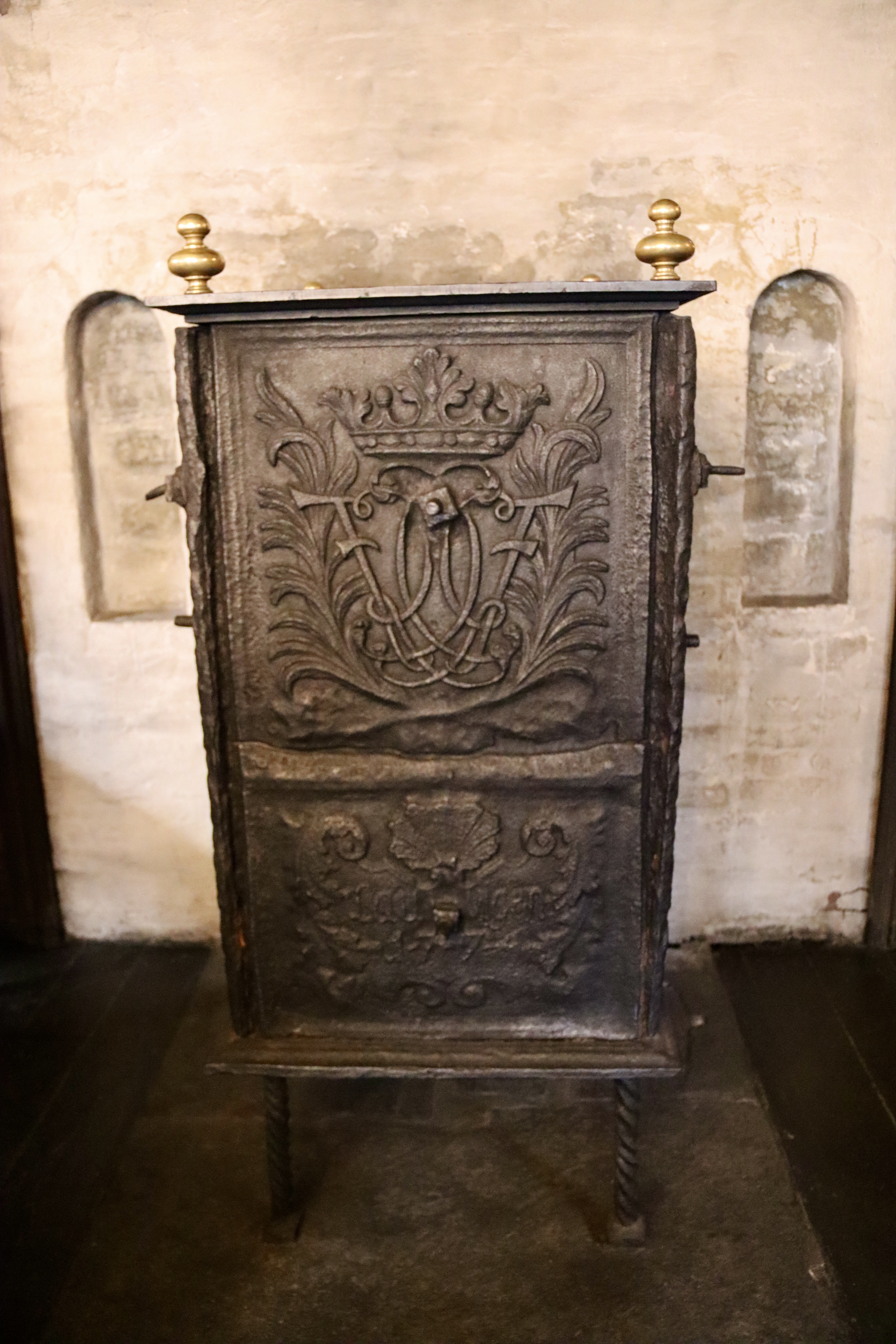
The kitchen area was downstairs and was built of stone and a metal stove was built into the dining area above. To ensure fire safety, it was fed from the kitchen so there were no open flames in the dining room. A tile was placed over the chimney top to stop sparks flying out and landing on rooftops. Some of the rooves and buildings were coated with tar to combat the intense elements, but this meant the exterior was flammable. Hmmm, could that be a problem? Imagine if they'd built with stone.

Where the important people sit.

The assembly halls were multi-purpose communal buildings that also served as courthouses and general meeting places. It was also a heavily male dominated society, hence the sexualised punishment of being whipped with a bull's penis. You can't make this up. Who comes up with this stuff? It takes a lot of effort to make a 'cane' like that. And wouldn't it be so emasculating? Or should that be homo-erotic? I'm undecided. Either way, it's just weird. Or private boys' school. Or both.

The stove heating the hall, fed from the kitchen.

These were tough times that weren’t made easier by the climate or the choice of building materials.

A row of pots in the kitchen.


St Mary’s
The stone church was more of a walk-by on the way back to the bus, although Ani recommended that we return and go inside later, if we had time. Apparently, it is quite beautiful. 

Looks good from the outside.

And return we did, the next day to discover that opening hours this time of year equated to Fridays 12-2pm. We walked around the perimeter, like the other disappointed tourists, snapped a few photos and continued on our way. When it re-opened, we would be aboard a train to Oslo.
That's about all we could see.


On the bus
Back on the bus, we were treated to a guided drive around Bergen itself. The second largest city in Norway, Bergen is apparently still getting over the fact that it was once the capital and home to the royal family but now one of its main claims to fame is as the wettest city in Europe. It's not the only European city still lamenting a lost past. I'm looking at you Vienna.

The drive was a fascinating look at Bergen and its history. We passed the fish market and were recommended a restaurant to try. The outdoor market has yet to open for this season. Not far away was another community of wooden houses, all painted white. They were almost totally destroyed in WWII but a rebuilding and restoration program has ensured they will be around for a while longer.

Flowers are hard to come by at the moment.

Up the hill we went past a grassy, park-like area with views back to the harbour. Quite a pleasant spot, until it was explained that is where Bergen’s witches were burned at the stake. It seems an intelligent, opinionated woman was not trusted in Norway either.

The “new” church, was built in 1763. Not quite so new. Back in the day it was given the tag and it has stuck. The new church is visible from many parts of Bergen and I’m sure it a significant landmark. However, it is currently wrapped in plastic, Laura Palmer style, as work is carried out on the exterior of the building.

They love trolls in Norway.

There is an interesting statue of Henrik Ibsen that turned out to be across the road from our hotel. Ani described him as “the second greatest playwright in the world. After Shakespeare.” Hmmm. Not sure about that. How about Chekhov? Or Pinter? Or Beckett?

Ibsen has crazy eyes.

We also drove by the area where it is mostly student accommodation. Bergen, after all, boasts two universities and the students account for almost 20% of the population. In contrast, we also toured the most expensive suburb. What made it so expensive? Well, price obviously, but why? It was the part of the town that received the most sun. Now that I completely understand.

And that's where I'll end it for today. I need to split Bergen into two posts otherwise you'll never get anything done, dear reader.

Until next time.