2023/11/13

Buddha Baby (Phnom Penh, Ko Chen, Oudoung, Cambodia)

On Thursday morning, we arrived in Phnom Penh but there would be no tourism, dear reader, until the authorities had face-checked our passports. Following breakfast, we adjourned to the lounge for our face inspection. What I thought would be a fairly time-consuming process turned out to be brief and efficient. We presented our passports, with Cambodian visas, to the official, he looked at the passport picture and compared it to our facial reality. A smile. A nod. We were done.

On reflection it may not have have been a smile, but a smirk. Imagine having the job of checking everyone's unsmiling likeness on their passport. Could you do it without smirking?

A weather report is unnecessary, but for the sake of repetition: hot and humid. The temperature is above 30° and the humidity is higher than 70%. Soupy, we would say at home.

There was the usual shock as we walked from our air-conditioned world to reality. It was short lived because it was straight onto the bus which dropped us at the street entrance to Koh Chen, the silversmith village. Our endpoint was supposed to be over 1km through the village; it didn’t seem that far and the pace was leisurely.

A stupa in Koh Chen.

We ran the gauntlet of the pedlars, waiting for us to disembark the bus. We were warned not to speak to them at all. Engaging in conversation is tantamount to an agreement to buy from them. Despite being ignored by everyone, they were persistent and refused to go away, just like Scott Morrison and Tony Abbott.

A silversmith at work.

This particular village of silversmiths is 200 strong but they are all that is left of this trade community, after Pol Pot. They made the decision to stay together and to continue the traditional methods of silver work. They also work with copper, brass and silverplate. We went into one workshop and were able to see the smiths at work. The female proprietor showed us how to tell the difference between genuine silver and silver plate. It’s easy if you carry polish with you. The silverplate rubs off.

A giant brass pot.

After a futile attempt to purchase Jayne a silver turtle for her Pandora and finding nothing else to spend my money on, we walked across the road to get into our tuk tuk that transported us back to the bus. It was a much more comfortable ride than the cyclo, physically and emotionally. I wasn’t concerned for our driver because he had a motorised vehicle.

The line of tuk tuks.

Next stop was Oudong, the former capital of Cambodia and the site of the largest Buddhist temple in the country. En route we had some of the vagaries of Buddhism explained to us. This site, aside from having the temple with its monks, also had accommodation for priests and nuns. The nuns and priests are below the monks in the pecking order and do not have to commit to as high a level of devotion, in terms of following the precepts of the Buddha. It's pretty full-on, Google it dear reader. It was too strict for me, no alcohol, no sex, no bad language. WTF? The nuns and priests dress in white and they reside in accommodation on the grounds, having their meals provided by donation from the surrounding community.


The temple.

Our guide termed this arrangement to be akin to aged care or retirement living in developed countries. For example, a woman who cannot provide for herself, or needs respite from the demands of the world, or who has health issues, mental or physical, can expect to be welcomed into this haven for a short period of time or for life, whatever meets her need. It comes at a price though, austere life, shaved head - good times in your later years.

There are levels of accommodation ranging from pretty basic one room huts up to substantial buildings that have been constructed by women’s families.

Basic accommodation.

Not so basic accommodation.

The temple precinct is quite expansive and some of the garden areas are beautiful and tranquil, designed for people to be still and meditate. The one drawback was the stray cats and dogs that were everywhere. The Buddhist belief in reincarnation makes it problematic to remove them.

The view over part of the gardens.

The monks are forbidden to eat after 12pm and we were scheduled for a blessing just prior to this. A blessing can take up to 90 minutes, we had the discount version. It was supposed to be 15 minutes, but was even briefer so the monks could have lunch. I hope our souls are OK.

Murals on the walls and ceilings.

The temple itself is massive and as imposing as any Christian cathedral or Jewish synagogue, but without the same excess. There wasn’t the same level of opulence, for instance, the gold wasn’t real. The space inside was vacant except for a giant statue of Buddha, the Siddhartha Buddha, not the fat, laughing one. The walls and ceilings were covered with murals of the Buddha’s life.

Buddha watching over proceedings.

Feeling blessed, it was back to the bus and eventually the ship for lunch. We had some free time which allowed me the opportunity to find an ATM and get some American dollars, the preferred currency. The only challenge here was the need to cross the road. There was slightly less traffic than Vietnam, but it moved more quickly. It was a public holiday, so the roads were busy. No sign of a pedestrian crossing or a break in traffic. I did what any Redfern boy would do, waited for a half break and made a run for it. Money safely pocketed, I sprinted, oh alright, moved very quickly back across the road to safety.

The market entrance

The first bus to the central markets left at 2:30pm. This market was the only one permitted to operate during Pol Pot’s regime. It is quite expansive and navigation can be an issue if you are attempting to cover every part of it. The central market is a dome and there are five arms radiating from it. Each of these arms leads to an outer ring, although it’s not quite circular.

Stuff.

More stuff.

If you are in the market (see what I did there?) to purchase something, you’ll find it here. Clothes, material to make clothes, watches, rings, jewellery, sunglasses, electronics, kitchenware, tableware, flowers, cosmetics, underwear, the aisles went on and on. It is the place to buy “genuine fakes” in Cambodia and the locals shop here because the quality is good and they can’t afford name brands. So we were told.

Pretty.

Mmmm. Yum.

The air inside the dome is oppressive and there are times where it seems to be non-existent. Almost sauna like except it’s still humid. It has the effect of hurrying the haggling. We bagged some name brand ‘bargains’ and continued our circuit finding more and more arms of the market to explore. The fresh food section was interesting. Fish, prawns, chicken, beef, frogs, all laid out for purchase, and something that was alive but unidentifiable, in a pot of bubbling aerated water.

Our time was nearing the end and we made our way back to the bus area searching for one more bargain. And there it was, a Louis Vuitton Pikachu t-shirt for $10US. Seriously, for a knock-off, no way. $5 said Jayne. “No, no,” was the reply. So, we walked. She didn’t follow. No deal. Sorry Dave.

Pre-dinner that evening, there was a student performance of traditional Cambodian dancing. It comprised of four different dances. The traditional dance of the girls, a story told in dance about the monkey king, the coconut shell dance and that really dangerous dance where you can have ankles broken between two very thick poles.


The best dance of the night called for audience participation. Thankfully, I was not selected, but Jayne was … centre stage with the girls doing the special hand movements. A photo dear reader? Yes, I have some, but I'm not stupid enough to post one here. I like living. However, for a small fee ... DM me.

I was scared. One false step.

Then it was cracker night. Ok, ok, fireworks. Independence Day celebrations go for three days here and we were well positioned to see the fireworks from our mooring. It was first real excursion to the upper deck. There was a breeze but it was still quite warm. Fireworks don’t hold any great fascination for me. I am uncertain whether the root cause is age or the overdose of fireworks we get in Sydney.
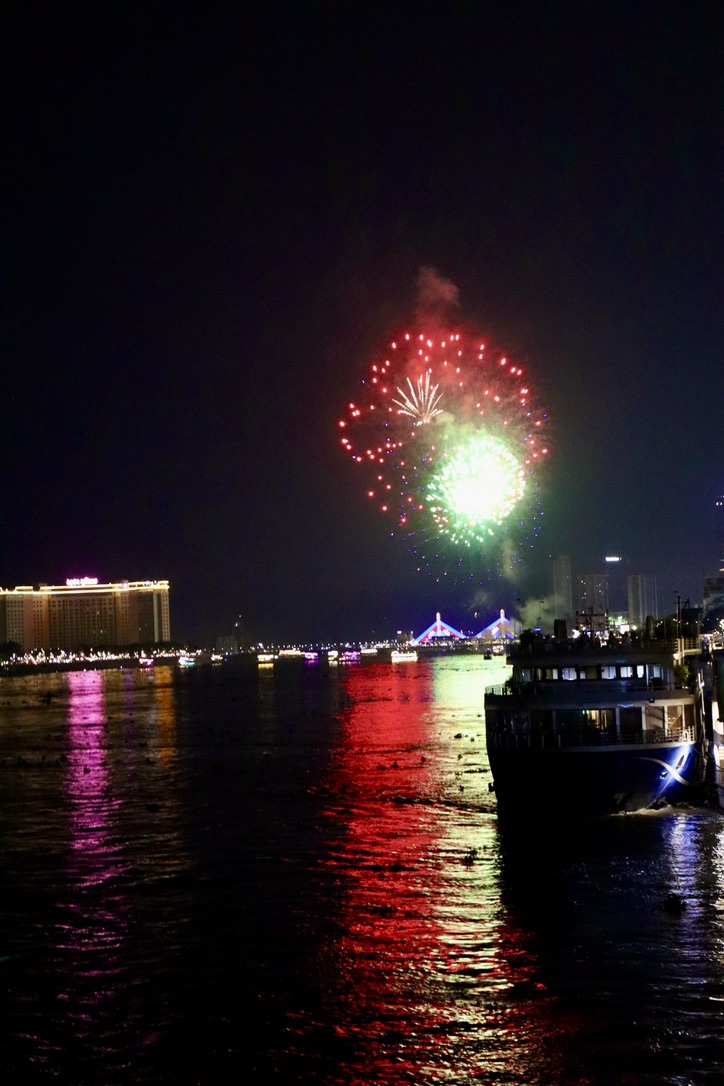
Cracker night.

Regardless, it was dinner time. Back to the restaurant for another lovely meal. Then upstairs to see the “American superstar”. I was expecting some Elvis impersonator, but no, it was an American guy, late 70s, with a guitar, singing ‘classics’. Well they are if you’re my age.

Oops, almost forgot to reference the title. It is, of course, one of my favourite Australian groups, Leonardo's Bride. Buddha Baby. Enjoy.

Until next time.


2023/11/12

Evergreen (The Mekong River, Tan Chau, Vietnam)

The routine is established. Breakfast at 7am. Leave the ship by 8:30am. You must be wondering by now, dear reader, why I haven’t mentioned coffee. My excitement over the Nespresso machine at the Park Hyatt in Saigon was not carried forward. Coffee at breakfast is served in one of those pots that belongs to a drip filter machine … from the 1980s. APT gets so much right and then the coffee faux pas. I suppose you’re right, my astute reader, not everyone is a coffee snob like me. Perhaps they should be and then I would not be suffering through breakfast, drinking tea.

Breakfast has all the usual offerings: local food, typical continental buffet, cereals, pastries, toast, fruit and a plethora of egg dishes. Given the over-feeding, I keep my breakfast simple, muesli, pastries, fresh fruit and tea.

Everything happens on the river.

Today’s activity takes us to an island that was once the sight of a Vietnamese killing field. They have since re-named it Evergreen Island to assist in removing the sad memories. Unlike other parts of the world we have visited, the Asian culture is about moving on and not dwelling on the past.

Working together.

It was a 15 minute boat ride down some tributaries to get to Evergreen Island. And Evergreen is a fairly obvious choice for today's title by the brilliant Barbra Streisand

My choice of seat was unfortunate and I spent my time trying to shield myself and the camera from water splashing over the bow. Our guide, Thinh, pointed out the specialist fishing boats that trawl, with their triangular nets, close to the shore. They catch the fingerlings that are used to make fish sauce, a staple of Vietnamese life.

Catching the lifeblood of the nation.

Further down the river and into a tributary, we passed floating villages, barges, too many fish traps to count, and numerous farms before we reached our destination. There was a fisherman, using electricity to electrocute the fish. It's an easy, if not illegal and dangerous way to catch them. It was hot and extremely humid again as we wandered down the tree lined lane, observing how the local farmers live their lives. On the way we met a 92 year old lady, working by the side of the lane.

Electrocuting the fish.

As if by magic, one of the local farmers had returned from the fields early and we were invited in to hear his story. He was in his 70s and one of 13 children. Originally, he fought with the South Vietnamese army until he was wounded. He then moved down to Evergreen to get away from the fighting. Good in theory. The VC arrived after a while and he was ‘encouraged’ to join them. In essence he fought for both sides – a guaranteed winner.

Fish traps.

We were then invited to walk through his house. I passed on this because it felt a little voyeuristic. The undercroft of the house had a clearance of over 2 metres. The last time it was rebuilt, after a fire, they raised it another 30 cm above the highest flood line. The backyard contained a couple of cows, chickens and some vegies.


The meander through the village continued as we wound our way back to the tributary where our sampan was moored. The main game was to avoid being in the direct sun. The heat and humidity were problematic. We motored down the creek, back to the main river and moored there. There was a little walk in front of us, through another area of Tan Chau which proved more challenging than it should have been because of the heat. There was also no air movement to speak of. The main industry here was weaving mats.

Drying the dyed reeds.

The factory was also stifling. There were two looms in operation and the female workers were threading individual fibres into the machine. The mats were patterned, rather than being all the one colour. Only skilled operators scored this role because they needed to remember the exact colour to slide into the loom. And it happened quickly.

You need to think quickly.

On the other side of the factory was a lone woman. sitting in front of a fire. A fire! In 35° heat with 70% humidity. She was constantly feeding the fire to keep the trough of water boiling as the fibres were being steamed. Clearly, she drew the short straw. The final station was where the edging was sewn onto the matting. This was away from the noise and the heat of the main factory.

I start sweating just looking at this picture.

It was then gift shop time. Again, they sold the ‘slaps’ of my teen years. You remember, dear reader, those thongs made using rattan with velvet straps. Much kinder to your feet than thongs. I didn’t purchase any because they didn’t have my colour – green was the colour back in the day.

Fortunately, we didn’t have to walk far to the next destination. It was down the lane way to the main road where many, many cyclos were waiting. Think rickshaw, but with a bicycle at the front to expedite movement. They are more solid than they appear and can be challenging to alight from or to get into for that matter.

The silk factory.

We were transported to a silk factory. I was extremely doubtful about this. It was a factory with 90 looms. Not a mulberry tree or silk worm in sight. Typical though, isn’t it? The capitalists always forget the worker worms and yet, without them, they would be nothing.

Loading rice.

There were two looms in a demonstration area where we were shown reels of silk and it was explained how the patterns are created in the material. They actually have the weave pattern imprinted on a paper scroll that looks like the roll on a pianola. It runs through the loom, directing the pattern to be woven into the silk material.

We were led through the house of the owner. Weird. There was an alternate way to the factory so I’m not sure what that was about or even why it was necessary. The noise of half a dozen of the looms in the factory was deafening and I can’t image the cacophony if they were all in operation. Industrial deafness is a thing. They actually said they do not wear any ear protection because they have to be able to hear the looms in operation, in case a thread breaks or something else happens that requires them to stop the loom, mid-weave.

A curry plant.

After a visit to the ubiquitous gift shop it was back into a cyclo and on to the ship.

After lunch, Long, our Cruise Director, gave a talk on Vietnam and covered some of the topics that you won’t find in the history books. It was often a very personal perspective from someone who had been a ‘boat person’ and was forcibly returned to Vietnam. Amazingly resilient people whose country has been constantly invaded/colonised and yet they keep smiling.

Brush for fencing.

That afternoon, we set sail for the border between Cambodia and Vietnam. The visa process was completed for us on board the Serenity. They already had our passports. It was a smooth transition that did not involve us directly.

Prior to dinner, I went for a complimentary massage. It was deep tissue, allegedly. It was good and she knew what she was doing but it wasn’t deep tissue like I have at home. Not that that is a bad thing.

You don’t really need to read about dinner. It was superb, as you might expect. We eschewed the entertainment as it was a movie about Pol Pot and we headed for bed as the Serenity continued down the Mekong toward Phnom Penh.

Until next time.


2023/11/11

Sail Away (Ho Chi Minh City to the Mekong River, Vietnam)

If I was at home, dear reader, the only reason to be out of bed at 5:30am would be to go riding. While I’m travelling, that time is becoming the norm for getting ready for breakfast and the excursion that follows. Can’t say I’m embracing it.

These devices are to stop scooter riders taking a shortcut on the footpath.

Breakfast was another spectacular experience. Jayne indulged in French toast which she reported was delightfully light. Amongst the array of pastries this morning, there lurked a plate of pink donuts. I regularly joke about purchasing one from the Woollies Metro at home, so Jayne goaded me into having one. I could only manage half a donut. The nuclear-irradiated pink icing was too sickly-sweet and the donut itself was more of a bread consistency. I wonder to which national group this was catering?

That's a helipad on the side of that building.

After breakfast the choice of activities was a shopping expedition. Nope. A motor scooter ride. Ah, no, not for Jayne. A trip to the food market and a cooking class. Definitely not. Or a wander through the local area. That was more our style. Or so I thought.

Weddings everywhere. It must have been Sunday.

As it eventuated, the pace was torturously slow and the ground covered took in much of what we did yesterday afternoon. The bonus was it came with an explanation of what I was seeing. This was a walk past tour, the only building we entered, aside from a café was the Post Office. We saw the former CIA building where the locals queued on the rooftop in the hope of being airlifted by an American helicopter and other sites of significance from the days of the American war.

Notre Dame in Saigon. Attractive.

We dawdled towards the markets down ‘shoe’ street where our guide Minh confided that the designer shoes were all knock-offs. The markets remained out of reach and we stopped for coffee at the Amazon Café. Then it was time to snail our way back to the hotel.

The famous rooftop.

You think I’m exaggerating about the lack of pace, dear reader. Let me provide an illustration. My Apple watch records my activity. If I neglect to register a walk, it prompts me. In the 2 hours we were walking my watch prompted me not once. By the time we had reached the hotel and completed the 3km, my active time was 2 minutes.

A very cool post office.

Upon our return to the hotel, we had about an hour to vacate the room, check out and join the rest of the tour group in the ballroom. Cruise registration occurred here and we were briefed on the transportation to the Mekong River cruise ship. We were in the green group. This was mostly the people from Hà Nôi and some people that were commencing their trip in HCMC. There were three bus groups heading out of Saigon towards the marina where the newly commissioned APT Serenity awaited us.

The former American Embassy and those famous gates.

The bus trip was typical of other recent journeys, with commentary provided this time by our local guide, Thinh, who comes from the Mekong Delta. An hour and a half later, we arrived for a quick cabin check-in and met our butler, Benly. He showed us around our beautifully appointed suite which would be home for the duration of the Mekong cruise. Finally, a chance to stop living out of our suitcases!

Our first sunset on the Mekong.

In the week before we left Australia, APT contacted us and offered a cabin upgrade for 50% off the usual rate. The extra room would be welcome so we said yes. There were some other perks that came with the upgrade, that we could live without. The cost of the upgrade to the Bayon suite was definitely worth it.

A very deep spa bath and dual basins.

We quickly oriented ourselves and went to our first onboard lunch, a typical APT culinary experience with multiple options for each course, served by lovely staff such as Sally and Maria who magically learnt our names before the appetiser plates were cleared.


Looking from the picture window.

After a short period to luxuriate in our suite, the peace was interrupted at 4pm by the anticipated alert to grab our cumbersome life jackets and head to the top deck to attend the compulsory safety drill. 

Back down to our level, it was time to dress for the welcome cocktail party with the captain and various heads of service. Thankfully this was much more casual than we have experienced on other cruises. Once the obligatory toasts were out of the way, we were left with Long, our cruise director, who provided (as his name suggests) a briefing that wasn’t very brief, about the next day’s programme.

Then it was back to the Lemongrass Lounge for another multi-course meal. Following dinner, we were invited to enjoy the musical entertainment provided by local farmers, including as it happened, our green group leader, Trinh. They played traditional Vietnamese instruments and acted out varying scenes depicting local life.

Water hyacinth. An introduced scourge.

Now part of a broader group of fellow travellers, we discovered that there were three groups that had converged to sail on the Serenity on the Mekong from HCMC to Siam Reap in Cambodia. There is our original tour group that started off in Hà Nôi and then flew to HCMC via a short sojourn on Ha Long Bay. There is a group who commenced the trip in Hà Nôi and then eventually came south via Sapa and Hoy An. Then there is a third group that simply arrived in HCMC to go on the Mekong cruise. Some of our fellow travellers should have been here earlier in the year but had their original tours cancelled. This was due either to delays in the construction of the new flagship, Serenity or because the Vietnamese authorities refused to grant a licence to the ship, despite the head of APT coming to Vietnam to try to sort whatever the issue was.

He looks friendly.

The next morning was the usual early start. However, we were now on the water and travel to the shore was by sampan. We motored across the river toward the town. A number of us encountered issues with our cameras. The lenses had fogged up due to the temperature differential from air-conditioned comfort to the heat and humidity. Wiping the outside lens clean was ineffective because the second lens and even the mirror inside the camera were also fogged. The only solution was to wait for the camera to warm up to the ambient temperature.

Making rice paper.

Caramel sweets.

Puffed rice.

The first stop was a shop where we saw a demonstration of how to make by hand caramel sweets and popped rice breakfast food. They also had a python in a cage for reasons I do not understand, except perhaps to amuse tourists. Sticky rice wine was also distilled on a premises a few doors down. It is a cousin of Chinese white liquor and just as deadly as 37% alcohol – 48% if you were intending to use it for medicinal purposes.


Only 5% cobra venom. I prefer something stronger.

Next to the bottles of banana wine and guava wine were bottles that contained a cobra with a large scorpion in its mouth. This liquid is supposedly medicinal. It’s good for lower back pain and assorted aches. The magic ingredient is cobra venom. At 5% per volume of liquid I decided not to try it. Jayne rejected my offer of buying a bottle for her to assist with her problem ankle. It wouldn’t get through Australian customs anyway.

The still.

Back onto the sampan we crossed the river to visit the Catholic church and hear about the history of Catholicism in the area. The roof didn’t cave in as I entered the church, nor was I struck by lightning, so that was a good start. The altar was covered in a plastic Christmas tablecloth. Stylish in a kitsch sort of way. The statue of Jesus behind the altar was surrounded by a red neon tube. I haven’t seen anything like that in Vogue for Churches.

Tacky without being gaudy.

Back on board the Serenity it was time for lunch and then a nanna nap. The weather closed in on us rapidly and a thunderstorm arrived before the next excursion. It was clearing as departure time neared, but we, like many others, opted not to do the afternoon tour. While tours like this allow you to get to places that you might not visit, the lack of down time to process your experiences or to just rest is rare. When an opportunity presents itself, it should not be passed up.

Dinner was the usual APT offering of four courses and wine. Our server, Sally offered the usual wines and we discussed the fact that the red was being served too cold. No problem said he and disappeared to return with a bottle that was close to room temperature. Excellent service. He put the bottle aside for us for the evening.

Our second sunset.

Yes dear reader today's title is somewhat of a cop out, but I didn't want to revisit war songs. Sail Away by Enya, it's one of those songs you can loop and just chill.

Until next time.


2023/11/09

I was only 19 (Long Tan, Vietnam)

Ah, holidays. Whatever they are. The alarm was set for 6am, dear reader, but I was awake at 5:30 and there was no possibility of further sleep. We readied ourselves for the day’s excursion and went to the restaurant for breakfast. As one might expect, the array of food on offer was extensive. The menu listed breakfasts to cater to specific nationalities. There was no Australian breakfast amongst the Korean, Japanese, French and American offerings.

OK, let's get the obvious out of the way. This post is named after the legendary Redgum song, I was only 19. Our tour guide maintained the song was inspired by an incident here.

Allegedly Frankie's evacuation.

You don’t really need breakfast on an APT tour if you can make it to lunch. Although the coffee was appreciated. I never thought I’d be grateful to see a Nespresso machine, but here we are. A double shot long black is the only way to begin the day. Ok, I’m weak, I also had some pastries and yoghurt and fruit for a health balance. Jayne is in omelette world and enjoying the daily selection of eggs.

There were a number of activities on offer today, the Long Tan experience and a trip to the Cu Chi tunnels were the most popular. We opted for Long Tan and were definitely in the minority, our group was quite small and led by Young (pronounced Yung) whose storytelling prowess was characteristic of Tea. It was quite a drive to the memorial, duration 2 hours, during which Young provided us with commentary about Saigon vehicles, wages, interest rates, internet rates, education and real estate.

Then.

Now.

The first leg of the trip was through District 2 which has become a haven for ex-pats. A very expensive haven. It is now the most expensive area of HCMC and lacks the frenetic pace and feel of Saigon. Once we were outside the city limits, the main pastime was watching the scooters zipping in and out of traffic. We saw scooters carrying lives ducks, a roast suckling pig, family members, fishing gear, boxes and other items. We stopped briefly in Baria for morning tea and to pick up our local guide, Binh. In case you were sceptical about how hot it gets here, there was a misting system that stretched the length of the front of the open café.

Back on the bus, we drove out into the centre of Phuk Tuy Province, the focus area for the Australian Army involvement in the Vietnam War. Within this province lies the port of Vung Tau, the Nui Dat Air Base and the Long Tan battlefield, now site of the only memorial permitted in Vietnam to honour foreign soldiers.

Binh provided very knowledgeable commentary about the organisation of the Viet Cong. He was also well versed in the broader context of both Australian and American politics of the 1960’s and early 1970’s. As we drove from Baria first to the site of the Australian Nui Dat army base, we were reminded of the era of Robert Menzies and Harold Holt, supporting John Kennedy and Lyndon B Johnson’s theory of the domino effect that would purportedly lead to world domination by the Communists. Realistically, Australia’s involvement had as much to do with Liberal Government philosophy and the white Australia policy as it did with the domino effect theory.

Binh also spoke about the locals’ respect for the Australian soldiers who were well trained and did their work effectively but never tried to destroy the local community or culture and in fact offered assistance and resources to help the Vietnamese people through a very difficult time.

There is nothing left to indicate that the Nui Dat site was once a strategically vital area – the physical terrain is still identifiable but we needed the photos and a map that Binh showed us to illustrate what the place looked like back in the 1960’s. It was the same when we drove a little further to the site of the airstrip. It is now an unremarkable-looking local road with houses on either side.

Then.

Now.

The memorial is located in the middle of banana and rubber plantations. Bananas! Jayne would have refused to fight there. Despite the bananas, it is now a very peaceful, rural environment but then, the scene of a very bloody battle in which the Viet Cong greatly outnumbered the Australian D company. The Australians who were surrounded, had superior gun power and expended 400,000 rounds of ammunition in the 4-hour battle. The casualties were much higher on the Viet Cong side but as Binh rightly pointed out, nobody wins in war – everyone lost fathers, brothers, sons, uncles who were all doing what their governments had told them was their duty.


The original cross. Now in the Canberra War Memorial.

Now.

Not often mentioned, when Long Tan is discussed in Australia, is the role the New Zealand artillery played. Constant bombardment by the 161st battery of the ‘enemy’ force provided vital support. Also rarely noted is that the Australian soldiers were trained and armed for battle, the VC forces were local farmers and fisherman who were recruited to defend their homeland, without any formal training and very little resourcing.

Before we walked the short distance from the bus to the memorial, we were told that the protocols for services are “no medals, no uniforms, no speeches.” Binh spoke briefly and then played the Last Post. We were fortunate to have a Vietnam vet as one of our fellow travellers. He was deployed there in 1969 with the 6th RAR and laid some flowers at the memorial. His presence added to the already sombre gravitas that we all felt as we tried to imagine the chaos and horror of what had taken place here over 50 years ago, as well as the ongoing impacts on those who lived through it.

Looking back from the memorial.

After the service, we headed back to Baria for lunch at the same establishment that we stopped at for morning tea. It was here that I saw something I have never seen before. Ice. Not so unusual. However, its use was amazing. The ice was placed in the individual urinal stalls. Apparently, the ice lowers the temperature of the surrounding area and assists in reducing the diffusion of aromas in a very hot climate.

Interesting.

Then it was time to bid farewell to Binh and to head back to Saigon for some free time in the city before dinner. Once again, our APT guide, Young, provided personal anecdotes to fill the 2-hour drive. We heard about his “official wife” and his only child, “the crown prince” who is apparently the “boss baby” in the household. Hmmm, official wife. I didn’t ask for an explanation. The other terms are obvious.

Once back in Saigon, we set out in search of the elusive Pandora shop, located in a large shopping mall a short walk from the hotel. After some examination of the local options, we decided on a piece, not dissimilar to the one purchased in Germany. After this success, we headed back to our accommodation, copping an afternoon shower that made the walk slippery on the Saigon footpaths. We can’t complain about the weather so far – this is the first time we have actually been rained upon since we arrived (although the wet season officially finished at the end of October).

Then it was time to change for dinner and another short stroll to Vietnam House, the restaurant operated by ex-pat, Luke Nguyen. We had high expectations as we have eaten at his restaurant in the Sydney Botanic Gardens. So, without going all ‘SMH Good Food Guide critic’, the food was average in a country where it has been pretty exceptional everywhere. While we felt sorry for the servers who had to negotiate many flights of stairs to serve and remove plates, the service was not co-ordinated and we’d had better meals, in our opinion, on the ship in Ha Long Bay. Perhaps this explains why the majority of diners were Caucasian.

Anyway, another day over, another series of firsts. A side trip to the money exchange on the way back to the hotel completed our activities. Bedtime.

Until next time.


2023/11/08

How long has this been going on? (Ha Long Bay to Ho Chi Minh City)

Fear not dear reader the title is not a repeat or a misprint. Carly Simon does a sensational rendition of the Gershwin classic How long has this been going on? A song that has been recorded by numerous artists. I chose this version over that of Ella Fitzgerald and Sarah Vaughan because I could echoes of Billie Holliday. Enjoy. It's worth a listen.

Another early morning start, dear reader, as the last excursion of our Ha Long Bay experience was a trip to a floating village. There is a number of these communities, dotted across Ha Long and Ha Lan, but the villagers are being encouraged by the authorities to return to living on land. Part of the reason for this is pollution of the waterways. They have tried to manage this through education programmes with some success. However, should a group not learn to live more cleanly with less environmental impact, they are relocated to land. Not a happy outcome for people who have lived their entire lives on the water. Therefore, over recent years, the floating village populations have declined.

Early morning light on the limestone.

At 6:45am, a light pre-visit breakfast was on offer but we felt we could forego this and wait till the post-visit brunch. An APT tour means you never go hungry. I’ve already started skipping meals or courses on offer. So at 7:30am, we joined the group on the tender to go to Cua Van village for a presentation and a tour conducted by locals.

The village has communal areas that are large open pontoon-type platforms, connected by ramps or simply tied up next to each other. Around the inlet, floating houses line the shore and you can walk from one neighbour’s house to the next. Each house has netted ‘tanks’ which contain fish that they have caught and are growing for later consumption.

One section of the floating village.

Transport around the village is by traditional row boat. The locals stand on a platform at the back of the boat which has seats for passengers. They then use oars to row forwards. Nothing happens at speed – you get where you are going when you get there, but no journey is any great distance.

Once we were on the pontoons, we were taken to the museum which presents a scale model of the village as well as cultural, historical and logistical information on the village. Like Australia’s First Nations people, this is a society whose continuity is supported by an oral tradition, in this case, song.

Once we had this background information, small groups departed for a floating tour around the entire precinct to see up close the houses and the other infrastructure.


The village has its own version of services. They have boats loaded up with all kinds of produce and products that criss-cross the village to provide home delivery shopping. A lady, by herself in a row boat, slowly rowed around the waterway, collecting with a net on a bamboo pole, any floating rubbish such as plastic cups or bags. I’m not sure she was winning the fight.

Every house has at least one hammock on the front porch and one dog. Obviously these things are not reliant on each other. On this Saturday morning, many of the locals were lazily swinging back and forth while they watched us tour past their homes. It occurred to me that you wouldn’t want to be a sleep walker around here or an unconscious midnight wander might end in a very rude awakening.

The ubiquitous dog.

Children attend primary school taught by teachers who live in the village from Monday to Friday. Secondary students must either go to the land-based schools (5am starts to get there) or go to boarding school.

We rowed around the village in one of the traditional boats. When I say that, we were actually rowed around the village by an old woman. The community is about one third of the size it used to be after many people were removed to the land because of the pollution problems. As we moved past the houses, the differentiation of wealth was obvious. Some houses had solar panels. Others had larger pontoon areas at their disposal. There were small boats for fishing and larger ones for squid fishing adorned with lights because they work at night and the light attracts the squid. The hammocks appeared to be occupied by the younger members of the community. The older people were mending nets, tending the fish or preparing food.

A squid boat.

Not everyone lived in a floating house, some lived on a boat. There were only a couple of these boats permanently moored but I doubt that they would be seaworthy, if they were required to move from their moorings.

More holes than swiss cheese.

Once the tour was completed, we were taken back to the ship and while we sailed back towards the marina in preparation to disembark, we vacated our rooms, checked out and went to brunch. The timing of check out was dependent on the ship reaching a location on the bay where there was enough internet signal for e-payments to be processed. Thankfully, when we arrived at the marina, we were spared another stint in the chaotic transit lounge as our bus was waiting to transport us to Hà Nôi’s domestic airport. Here Tea assisted us to seamlessly check in for our flight to Ho Chi Minh City (HCMC), scheduled to depart at 3 pm. Once all bags were checked and tickets issued, we went to the Lucky Restaurant, within the terminal, for a final meal with Tea, a light lunch.

Mending nets.

Tea is an excellent guide and has diversified his business to try and build a better life for his family. He has his own website where he sells bags and other merchandise. You can reach it here. On the bus trip to the airport, Tea phoned his daughter and a number of us had the opportunity to speak with her. She is a very confident young lady of 9 and was preparing for an English-speaking competition to be held the next day. Her English was extremely good. I hope she did well.

After that we sadly bid Tea farewell and headed through security, an interesting experience because, despite having to take off everything except our clothes (shoes, watches etc) we all set the alarm off for no explicable reason. Patted down, we redressed and headed to the crowded departure gate. Naked travel will soon be a thing.

We were interested to see what this flight would be like since, in early 2024, we will be travelling on Vietnamese Airlines for part of our next European excursion. Boarding commenced on time and we found ourselves squashed onto airport buses to be taken some distance away to the plane. With some trepidation, we located our seats in economy. Bonus!! We had scored the bulkhead row with additional legroom. Our glee was short-lived, however, as we quickly discovered that both crew and passengers saw the space in front of us as a thoroughfare to go from one side of the plane to the other so we were almost constantly moving our feet out of the way throughout the flight. Thankfully, the duration of the journey was less than two hours and we landed in HCMC to be met by another APT guide. After luggage retrieval, he steered our group out of the terminal and through the carpark to a bus to transport us to the Park Hyatt Hotel, a 5-star establishment in the heart of the Saigon retail district. This would be our home for the next two nights.

Cruise Director, Long, whom we had briefly met on our first evening in Hà Nôi, was waiting to greet us and expedite our check in. This was critical as we arrived after 6pm and were expected to attend the welcome dinner for the larger cruise group at 7 pm. By the time we made it into our room and the bags arrived, it was almost time to go to the mezzanine level where we saw the rest of our fellow travellers. There are around 67 in the group. Many had arrived earlier in the day and were already seated, socialising and eating. We all felt a bit frazzled but settled during dinner and had the opportunity to chat to Long, who outlined the organisation for the next couple of days and answered any questions. 

After the noise and rush of dinner, a couple of our group repaired to the quiet of one of the hotel bars for a calming nightcap before heading off to bed. Unsurprisingly another early start awaits us in the morning, as we head back out of HCMC to visit the Long Tan Memorial – a full day trip to the next province.

Until next time.